

Council websites help local authorities to deliver hundreds of different services. Many of these services have their own websites or are delivered through applications hosted separately to a council’s website. If the main council website goes down for any significant time then these council services can be impacted and unavailable as they can’t be found. So, in the event of an emergency what can council’s do to ensure that key services remain available in the event of a council website outtage?
Why does it matter if council services can’t be accessed online?
Councils deliver a wide range of services to residents and businesses, such as benefits, care, health, planning and waste and recycling. The main council website is the central point to access these services which it signposts and promotes. If the main council webiste goes down how can people access these services and how does the council continue to operate effectively?
If a problem occurs with the public website most people will probably pick up the phone and try to contact the council directly. In these situations council Customer Services teams have to step up and deal with a spike caused by increased phone traffic whilst online services are unavailable. For residents this can lead to delays and frustration; for the council it can lead to services not being delivered on time or to a loss in much needed income.
How likely is it that the council’s website goes down for any length of time?
When I was working as a web manager the likelihood of the website going down for more than a couple of minutes, let alone a couple of hours, was remote. In 28 years I can only recall a handful of occasions when this happened and certainly nothing more than 24 hours. Council web teams are generally tasked to ensure that websites are available 24 hours a day, 7 days a week and to maintain at least 99% availability.
The world has moved on since I was a web manager and not necessarily for the better. We now live in a world that is highly volatile and dangerous. Each day new threats and challenges emerge and countries worldwide are having to step up and be better prepared for emergencies. UK Prime Minister, Andy Burnham, recently said in the wake of online disruption caused by a security flaw in PHP that:
unexpected events seem to be becoming more and more common.
The recent security issue in PHP affected websites across the world. Many councils were forced to take down their websites to fix this security issue leaving many of these sites displaying only this somewhat unhelpful advice:
‘This website is temporarily offline.
This site is currently closed for maintenance. Please check back in a few minutes.’
Overall the recent PHP issue did not result in major downtime for council websites. Most councils weathered this storm through the expertise of the external suppliers managing their digital resources. That said councils can’t afford to be complacent.
What the PHP issue has highlighted is that councils need to consider the relience of their websites and have contigency in place for when things go seriously wrong. All councils will, I am sure, have a disaster recovery plan, so IT and web managers should consider revisiting what they have in place for safeguarding their web infrastructure.
How can councils improve website continuity?
Website continuity is the ability of a website to remain operational and accessible to users without significant interruption, even when facing technical issues or cyber attacks. It requires proactive measures and recovery plans to be put in place to minimize downtime and ensure consistent service delivery.
If the main council website goes down due to an emergency for any significant time that it can be temporarily replaced with something to allow residents and businesses to access key services.
One option would be to build a cut down version of the existing website which signposts key services, websites and web applications and which provides useful contact information.
During the recent PHP issue South Gloucestershire Council replaced the existing website with a holding page hosted on a subdomain of the main site. They have also added what they call a ‘temporary website homepage’, which appears to be a beta version of their main website.
This provides access to services which otherwise would be hidden from view. I personally think a single holding page or a more limited selection of pages signposting key services would actually suffice in the event of an emergency when the main website needs to be taken down.
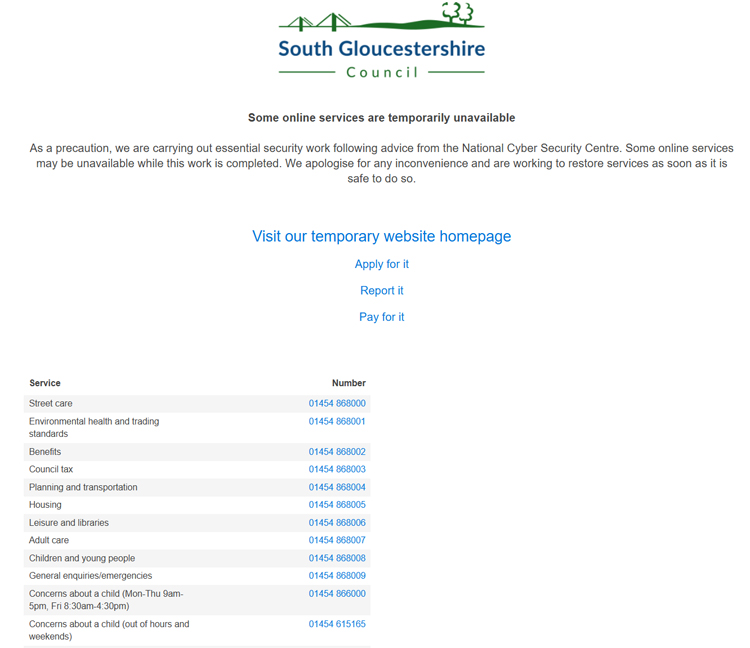
Moving forwards I would recommend that councils consider developing a simple holding page, with links to key services and useful contact information. Additional pages can be added, but I think there should be a limited number of pages signposting key services. This holding page can sit ready for an emergency and could be swapped out with the main website as required.
Full marks to South Gloucestershire Council for thinking out of the box and coming up with a quick solution in an emergency. Yes, the holding page looks a little basic, but something with a little more design could be developed in the background for when it is needed again. The holding page needs to clearly explain why it is replacing the main website and provide an opportunity to provide updates on progress with restring the main council website. This holding page needs also needs to signpost key services and provide key contact information.